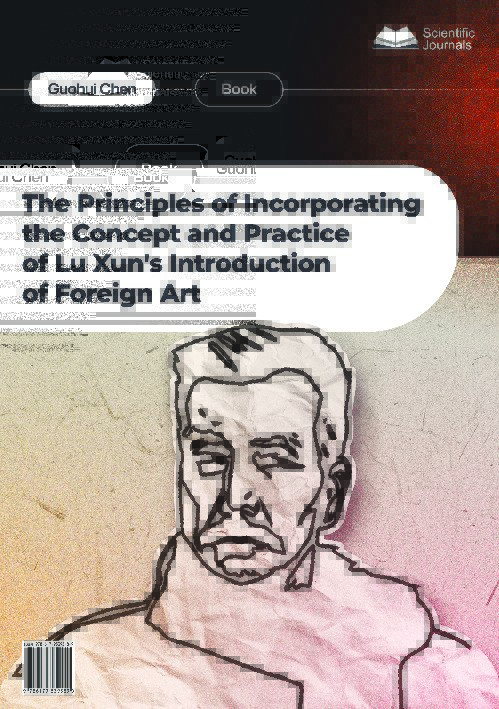
Принципи впровадження концепції та практики Лу Сіня щодо залучення іноземного мистецтва
Автори:
Ґохуей Чень
Ґохуей Чень, доктор філософії (1979-), є доцентом Гуанчжоуської академії образотворчого мистецтва, Китай. Протягом 25 років він займається переважно дослідженнями візуальної культури, історією та теорією мистецтва, опублікував 6 монографій, майже 40 наукових статей, а також працює науковим керівником докторантів з візуальної культури в Міському університеті Макао.
ISBN: 978-617-95395-8-9
ISBN: 978-617-95395-8-9 (eBook)
DOI: https://doi.org/10.61786/piclxifa2025-5
Видавець ТОВ "Наукові журнали"
Опубліковано – грудень 2025 р
Мова – Англійська
Кількість сторінок – 192 сторінок
Права: Ця робота поширюється на умовах ліцензії Creative Commons Attribution 4.0 International License
Ця монографія досліджує концепцію Лу Сіня «принципів інкорпорації», аналізуючи його підхід до інтеграції іноземного мистецтва в китайську культуру. Вона підкреслює, що його підтримка іноземного мистецтва була не лише теоретичною, а й активно практикувалась під час Руху нової культури, формуючи сучасне китайське мистецтво. Дослідження заглиблюється в мотивацію зусиль Лу Сіня, методи, які він застосовував, та конкретні форми іноземного мистецтва, які він запровадив. Також досліджується його мистецтвознавча діяльність, зосереджуючись на тому, як вона відображала його філософію «інтеграції». У статті розглядаються такі ключові теми, як розвиток доктрини інтеграції Лу Сіня, його підтримка молодіжного руху деревориту та культурний вплив його творчості. Досліджуються ідеологічні зрушення та зміни в китайському мистецтві в результаті іноземного впливу, висвітлюючи складнощі формування сучасного китайського мистецтва. Аналізуючи листування Лу Сіня, передмови та праці з теорії мистецтва, це дослідження надає цінну інформацію про історичний процес інтеграції іноземного мистецтва в культурну структуру Китаю. Воно має на меті надати глибше розуміння трансформаційної ролі, яку Лу Сінь відіграв у формуванні траєкторії розвитку китайського сучасного мистецтва, зробивши значний внесок у культурне просвітництво та художній розвиток.
Всі права захищені.
Ця книга або її частини не можуть бути відтворені в будь-якій формі і будь-якими засобами, електронними або механічними, включаючи фотокопіювання, запис або будь-яку систему зберігання і пошуку інформації, відому на даний момент або ту, що буде винайдена, без письмового дозволу автора.
Список використаних джерел
1. Ai, X. (1991). The Origins of Leftist Literary Thought in China. Hunan Literature and Art Publishing House, Changsha.
2. Bai, C. (1999). Written in Eternal Remembrance. In Lu Xun Memoirs. Beijing Publishing House, Beijing.
3. Bai, W. (1999). Recalling a Few Incidents Concerning Mr Lu Xun. In Lu Xun Memoirs. Beijing Publishing House, Beijing.
4. Bao, J. (1982). A Collection of Discussions on Lu Xun’s “National Character Theory”. Tianjin People’s Publishing House, Tianjin.
5. Beihong, X. (1996). On the Improvement of Chinese Painting. Shanghai Painting and Calligraphy Publishing House, Shanghai.
6. Bergson, H. (2011). An Essay on Laughter. China Social Sciences Press, Beijing.
7. Bunai, W., & Guanquan, W. (1981). The Great Fire-Bearer: A Discussion on Mr Lu Xun and the Introduction of Foreign Art. Fine Arts, 9.
8. Bunei, W., and Guanquan, W. (1981). The Rise and Fall of the 18th Art Society. People’s Fine Arts Publishing House, Beijing.
9. Changxi, S. (1981). Lu Xun on Artistic Creation. China Social Sciences Press, Beijing.
10. Cheng, L. (1917). The Art Revolution. New Youth, In Gu Sen & Li Shusheng (Eds.), A Century of Chinese Art Classics (pp. 3–7). Haitian Publishing House, 1998 edition.
11. Da, R., & Zhongxian, L. (1998). The New Policy Revolution and Japan-China, 1898–1912. Jiangsu People’s Publishing House, Nanjing
12. Dade, H. (2004). Research on ‘Fine Art’. Fine Arts Research, 2.
13. Danqing, C. (2011). Lu Xun and Fine Art. In Laughing at the Great Master: Seven Lectures on Lu Xun. Guangxi Normal University Press, Guilin.
14. Daohui, G. (1985). Lu Xun’s Aesthetic of the Great. Literary and Art Studies, 4.
15. Duxiu, C. (1916). Our Final Awakening. Youth Magazine, 1(6).
16. Duxiu, C. (1987). Collected Letters. Xinhua Publishing House.
17. Duxiu, C. (1996). The Revolution in Fine Arts. Shanghai Painting and Calligraphy Publishing House, Shanghai.
18. Fang, K. (1990). A retrospective and prospects for research on modern Neo-Confucianism.Philosophical Studies, No. 3.
19. Fang, K. (1991). Two issues that must be confronted when considering the future prospects of Confucianism. Tianjin Social Sciences, 1.
20. Fei, L. (1996). Lu Xun’s Complete Works. China Social Sciences Press, Beijing.
21. Feng, J. (1981). Mr Lu Xun and the “18 Art Society”. Liaoning Fine Arts Publishing House.
22. Gogol, N. (2009). Selected Works of Gogol (translated by Li Jixing). Fudan University Press, Shanghai.
23. Guang, C. (1958). Recording a Speech by Mr Lu Xun. In Recollections of the Great Lu Xun. New Literature Publishing House, New York.
24. Guangfu, Z. (1982). Lu Xun’s Collection of Art Essays. Yunnan People’s Publishing House, Kunming.
25. Guanglian, F., Liu, Z., & Tan, G. (2002). Lu Xun in a Multidimensional Perspective (1st edition). Shandong Education Press, Jinan.
26. Guangping, X. (1999). Lu Xun and the Chinese Woodcut Movement. In Lu Xun Memoirs. Beijing Publishing House, Beijing.
27. Guangqian, Z. (2003). History of Western Aesthetics. People’s Literature Publishing House, Beijing.
28. Guanquan, W. (1979a). Chronology of Lu Xun’s Art Department. People’s Fine Arts Publishing House, Beijing.
29. Guanquan, W. (1979b). Lu Xun and Fine Arts. People’s Fine Arts Publishing House, Beijing.
30. Guochang, G. (2006). The Debate on Popularisation in Twentieth-Century Chinese Literature. Baihua Zhou Literature and Art Publishing House, Tianjin.
31. Guoliang, P. & Liang, Y. (2004). Appraising Paintings and Graphics with Lu Xun. Yuelu Publishing House, Hunan.
32. Guoliang, Z. (1995). Principles of Communication Studies. Fudan University Press, Shanghai.
33. Guorong, Z. (1986). Lu Xun and the Art of the Human Figure. Art History and Theory, 4.
34. Guowei, W. (1906). On Detoxification: Fundamental Treatments for Opium Addiction and Future Educational Considerations. Education World, 129.
35. Hao, Z. (2003). The Significance of the Transformation Era in Modern Chinese Intellectual and Cultural History. In Zhang Hao Selected Works. Shanghai Education Press, Shanghai.
36. He, L. (1995). Translingual Practices: Literature, National Culture, and the Circulation of Modernity. Stanford University Press, Redwood.
37. Hiu, W. (1989). The May Fourth Enlightenment Movement in Modern Chinese History. Literary Criticism. Harvard University Press, Cambridge.
38. Hong, R. (1985). A Record of the Eastward Spread of Western Learning. Yuelu Publishing House, Hunan.
39. Hong, S. (2004). A Century of the Eastward Transmission of Western “Art History”. Literary Research, 4.
40. Hong, X. (1997). Recollections of Mr Lu Xun. In The Collected Works of Xiao Hong. Anhui Literature and Art Publishing House.
41. Hongbing, G. (1994). Martyr, Great Man, Madman: A Subjective Interpretation of Lu Xun and Van Gogh. Lu Xun Research Monthly, 5.
42. Hongda, J. (1986). Explorations into Lu Xun’s Cultural Thought. Beijing Normal University Press, Beijing.
43. Hua, H., Liu, J., Liao, B., Wen, T., & Huang, X. (1940). A comprehensive review of the Chinese woodcut movement over the past decade. Guilin Woodcut, Beijing.
44. Hua, L., Li, S., & Mark, H. (1981). Declaration on the Establishment of the Springland Art Research Institute. Liaoning Fine Arts Publishing House, Shenyang.
45. Huang, L. (1915). On the Need for China to Abandon Its Conservative Traits. Quarterly Bulletin of Students in America. Sanlian Books.
46. Huang, L. (1991). On Lu Xun’s System of “Incorporating”. Xinjiang Social Science Forum, 6.
47. Hui, W. (2008). Resisting Despair: Lu Xun and His Literary World. Sanlian Books, Beijing.
48. Jie, W. (2008). Aesthetics. Higher Education Press, Beijing.
49. Jinghua, C. (1989). Cao Jinghua’s Collected Translations. Hebei Education Press and Peking University Press, Beijing.
50. Jiyao, L. (2002). An Explanation of Lu Xun’s “Categories of Fine Arts”. Journal of Yangzhou University, 4.
51. Kagan, N. (1986). Morphology of the Arts. Sanlian Books, Beijing.
52. Kanzo, U. (1957). Some Recollections Concerning Printmaking. Printmaking, March.
53. Kazuko, K. (1988). Lu Xun and Hong’er of Fugu. Xuelin Publishing House, Shanghai.
54. Ke, H. (1989). Lu Xun and Children’s Art. Art History and Theory, 4.
55. Ke, H. (2006). A Brief History of Artistic Activities in China’s New Democratic Revolution. Shanghai Calligraphy and Painting Press, Shanghai.
56. Ken, W. (1932). Proletarian Artists and Their Works. Literary News, 6 June.
57. Kokon, K. (1958). Expressionism. In Lu Xun’s Collected Translations. People’s Literature Publishing House, Beijing.
58. Ku, L. (1999). Lu Xun’s Artistic Activities. In Lu Xun Memoirs. Beijing Publishing House, Beijing.
59. Lebedev, Y. (1957). A History of Nineteenth-Century Russian Book Illustration. Morning Flower Fine Arts Press.
60. Lei, F. (1933). ‘I Say Again: Where Are We Going? ... To Greater Depth!’. Art, January, p. 12.
61. Liqun, Q. (1986). Centred on “Establishing the Individual”: The Logical Starting Point of Lu Xun’s Thought and Literature. Journal of Fuling Normal University, 19(1).
62. Lunacharsky, A. K., Vasilyev, A., Fadeyev, A. (1949). Soviet Literary Theory Collection: Issues of Socialist Realism. Tangdi Publishing House, Chengdu.
63. Lynch, B. (2011). A History of Western Cartooning. Central Compilation & Translation Press, Beijing.
64. Meng, Z. (1979). Adopting the sound practices of other countries: Learning Lu Xun’s revolutionary spirit in introducing foreign art. Journal of Nanjing University of the Arts, 1.
65. Mengxi, L. (2008). Outline of Modern Chinese Scholarship. Sanlian Books, Beijing.
66. Moruo, G. (1963). Revolution and Literature. Chuangzao Monthly, 1(3).
67. Noboru, M. (2005). Lu Xun, Revolution, History: Selected Essays on Modern Chinese Literature by Maruyama Noboru. Peking University Press, Beijing.
68. Ou-fan, L. (1986). Lu Xun and Modern Artistic Consciousness. Lu Xun Research Monthly, 11.
69. Ping, X. (1981). Lu Xun and Genre Painting. Unity Daily, 1.
70. Plekhanov, G. (1962). Letters Without an Address: Art and Social Life (translated by Chenbao, F., & Minwang, Y.). People’s Literature Publishing House, Beijing.
71. Plekhanov, G. (1983). Aesthetic Essays. People’s Publishing House, Beijing.
72. Puxian, C. (1919). The Struggle of Marx, the Founder of Modern Socialism. Supplement to Morning Post, 1 April.
73. Qi, W. (1956). How Lu Xun Introduced Foreign Art. Fine Arts, 10.
74. Qi, W. (1986). Lu Xun on Modernist Art. Fine Arts, 10.
75. Qi, Z. (2010). Consciousness of the Soul in Lu Xun’s Literary Thought and Its Modernity (Doctoral Thesis). Chinese National Academy of Arts, Hangzhou.
76. Qichao, L. (2006). The Relationship Between Fiction and Social Governance. Zhonghua Book Company.
77. Qiubai, Q. (2012). Memoirs of the Red Capital: Miscellaneous Notes from Qu Qiubai’s Year in Moscow. Shanghai Sanlian Books, Shanghai.
78. Record of the Nanyang Industrial Promotion Exhibition. (1993). Quoted in Pan Jie, History of Chinese Exhibitions (p. 618). University of Electronic Science and Technology of China
Press.
79. Report by the Chief Inspector of the Industrial Promotion Exhibition Commencing Inspection. (1910). Guofeng Bao, Issue 20, p. 119.
80. Ruli, R. (1982). Record of Lu Xun’s Lecture at the Chinese Academy of Arts. Yunnan People’s Publishing House, Kunming.
81. San, X. (1983). Collected Works of Xiao San. Xinhua Publishing House, Beijing.
82. Shaojun, L. (1988). On Modern Chinese Art. Jiangsu Fine Arts Publishing House, Nanjing.
83. Shencheng, Y. (2001). On the “Incorporating” Approach. Journal of Guiyang Jinzhu University, 4.
84. Shih, H. (1923). Letter to Gao Yihan and Three Others. Nuli Weekly, 75.
85. Shih, H. (1996). Collected Works of Hu Shih. Huangshan Publishing House, Huangshan.
86. Shih, H. (1998). Further Reflections on Faith and Self-Examination. In Ouyang Zhesheng (Ed.), Hu Shih: Collected Essays. Peking University Press, Beijing.
87. Shiqiu, L. (1924). Does Literature Have Class Characteristics? The Crescent, 2.
88. Shirakawa, S. (1959). ‘Theory of Play’. In Lu Xun’s Collected Translations. People’s Literature Publishing House, Beijing.
89. Shisheng, P. (2002). On Lu Xun’s Early Essays and His Thought on Reforming National Character. Lu Xun Research Monthly, 9, 7–8.
90. Shiying, Q. (1921). Creation and Philosophy. Novel Monthly, 12(7).
91. Shouchang, X. (1961). Impressions of My Late Friend Lu Xun. People’s Literature Publishing House, Beijing.
92. Shouchang, X. (1978). Lu Xun as I Knew Him. People’s Literature Publishing House, Beijing.
93. Shouchang, X. (2010). Memoirs of My Late Friend Lu Xun. Guangxi Normal University Press, Guilin.
94. Shouchang, X. (2015). Lu Xun’s Self-Portrait. Contemporary World Press, Beijing.
95. Shouwei, S. (2005). On National Essence Not Hindering Westernisation. Journal of National Essence Studies, 7.
96. Shuhui, Y., & Yanli, Y. (1999). Understanding Lu Xun Through His Personal Belongings. Renmin University Press, Beijing.
97. Shuli, L. (1987). Lu Xun and Japanese Children’s Woodblock Prints. Lu Xun Research Bulletin, 10.
98. Sinian, F. (2000). Critique of China’s School System. In The Collected Works of Fu.
99. Soviet Academy of Arts. (1985). Collected Essays on Art: Marxist Critique of Western Modernist Literature and Art (p. 153). Cultural Arts Publishing House, Beijing.
100. Tao, W. (1985). Random Notes from My Wanderings. Qiulü Publishing House, Beijing.
101. Tao, Z. (2007). The Dissemination of Western Modern Woodcut in China during the Early Republican Period (1912–1936) (PhD thesis). Central Academy of Fine Arts.
102. Tiji, M., & Ding, P. (1984). Lu Xun and His Contemporaries. Spring Wind Literature and Art Publishing House, Beijing.
103. Tiji, M., & Yunjing, L. (1985). Lu Xun and the Emerging Woodcut Movement. People’s Fine Arts Publishing House, Beijing.
104. Tiji, M., & Yunjing, L. (1986). Chronological Record of Lu Xun’s Woodcut Activities.
105. Tiji, T. (1987). Chronology of Lu Xun’s Paintings, Calligraphy, and Bookbinding Works (Volumes I and II). China Federation of Literary and Art Circles Publishing Company, Beijing.
106. Trotsky, L. (1928). Literature and Revolution. Shanghai Beixin Publishing House, Shanghai.
107. Trotsky, L. (1992). Literature and Revolution. Foreign Literature Press, Beijing.
108. Wang, Z. (1955). Chronology of Lu Xun’s Artistic Work (Draft). Fine Arts, 9.
109. Wang, Z. (1956). Lu Xun on Beardsley’s Decorative Art. Fine Arts Research, 1.
110. Wang, Z. (1979). A Recollection: Memories of Lu Xun’s Artistic Activities. People’s Fine Arts Publishing House, Beijing.
111. Wang, Z. (1980). The Significance of Lu Xun’s Introduction of Foreign Art. Art Garden, 1.
112. Wang, Z. (1982). Lu Xun on Fine Arts. People’s Fine Arts Publishing House, Beijing.
113. Wang, Z. (1985). Lu Xun and Hong’er of Fugu’s Paintings. Art Research, 2.
114. Worms, P. (1981). Lu Xun and Maiseiler (translated by Wei Jun). World Art, 3.
115. Xian, L. (1982). How I Commenced Woodcut Engraving. In Chinese Printmaking Yearbook.
116. Xian, Z. (2005). Critique of Aesthetic Modernity. Commercial Press, Hong Kong.
117. Xiaohui, J. (1986). Understanding Lu Xun Through His Library: Lu Xun and Japanese Ukiyo-e. Fine Arts Garden, 4.
118. Xiaolin, X. (1984). Lu Xun on Models and Other Matters. Meiyuan, 2.
119. Xiaoping, M. (2000). Lu Xun and Folk Art. Lu Xun Research Monthly, 9.
120. Xingzhi, X. (1930). Prospects for the Chinese Art Movement. Shalun, 1(1).
121. Xinqi, W. (1986). Chronology of Lu Xun’s Artistic Career. Lingnan Fine Arts Publishing House, Guangzhou.
122. Xinyu, L. (2013). Shame Before Lu Xun. Twenty-First Century Press, New-York.
123. Xipei, X. (1986). Welles Introduces Chinese New Art: Historical Materials on Lu Xun and the Art Nouveau Movement, Part One. Fine Arts, 10.
124. Xipei, X. (1991). Lu Xun’s Selection of American Cultural Values. Lu Xun Research Monthly, 11.
125. Xirong, W. (2009). Lu Xun’s Artistic World. Jiangsu Literature and Art Publishing House, Jiangsu.
126. Xuantong, Q. (1999). Collected Works of Qian Xuantong. Renmin University Press, Beijing.
127. Xueqing, L. (2004). Printmaking: Composite Form Prints. Artist Publishing House, Taiwan.
128. Xuezhi, J. (1987). Lu Xun on the Aesthetics of Seal Carving. Lu Xun Studies, 11.
129. Xulu, C. (1992). Metabolism in Modern Chinese Society. Shanghai People’s Publishing House, Shanghai.
130. Xun, L. (1913). Proposed Memorandum on the Dissemination of Fine Arts. In Collected Works of Lu Xun. People’s Literature Publishing House, Beijing.
131. Xun, L. (1976). Collected Letters of Lu Xun. People’s Literature Publishing House, Beijing.
132. Xun, L. (1981). The Complete Works of Lu Xun. People’s Literature Publishing House, Beijing
133. Yanqiao, C. (1943). Lu Xun and Woodcut Art. Guilin: Literary and Art Magazine, 2(2).
134. Yichuan, H. (1981). Recollections of Lu Xun and the 18th Art Society. People’s Fine Arts Publishing House, Beijing.
135. Ying, S. (1979). Lu Xun at the Ministry of Education. Tianjin People’s Publishing House, Tianjin.
136. Ying, W. (1993). Lu Xun in the Fine Arts Perspective: A Review of Studies on Lu Xun’s Artistic Activities. Lu Xun Research Monthly, 1.
137. Yingwei, T. (1946). A History of Modern Chinese Woodcut Art. Guilin Woodcut Society, Beijing.
138. Yongde, Y., & Ning., Y. (2007). Lu Xun’s Final Twelve Years and Fine Arts. Culture and Arts Publishing House, New York .
139. Yoshikichi, U., & Kazuo, N. (1985). Lu Xun and Woodcut Art. People’s Fine Arts Publishing House, Beijing.
140. Youwei, K. (1908). On Saving the Nation Through Materialism. Guangzhi Book Bureau, Guangxi.
141. Youwei, K. (1996). Catalogue of Paintings in the Wanmu Studio. Shanghai Calligraphy and Painting Press, Shanghai.
142. Yu, S. (1997). Lu Xun and Zhou Zuoren. Hebei People’s Publishing House, Shijiazhuang.
143. Yu, S. (2008). Catalogue of Lu Xun’s Art Collection. Huacheng Publishing House, Guangzhou.
144. Yu, S. (2013). Lu Xun and Chen Duxiu. New Youth, 4(2).
145. Yu, S. (2015a). Lu Xun and Russia. People’s Literature Publishing House, Beijing.
146. Yu, S. (2015b). Lu Xun’s Collection of Paintings. Huacheng Publishing House, Guangzhou.
147. Yuanpei, C. (1920). The Origin of Fine Arts. In Cai Yuanpei: Selected Aesthetic Writings. Peking University Press, Beijing.
148. Yuanpei, C. (1983a). Speech at the Opening Ceremony of China’s First National Academy of Fine Arts. In Cai Yuanpei: Selected Aesthetic Writings. Peking University Press, Beijing.
149. Yuanpei, C. (1983b). The Aesthetic Education of China in the Past Twenty-Five Years. In Cai Yuanpei’s Selected Aesthetic Writings. Peking University Press, Beijing.
150. Yuanpei, C. (1984). Opinions on New Education. In The Complete Works of Cai Yuanpei. Zhonghua Book Company, Beijing.
151. Yuhong, Z. (1995). Incorporating and Lu Xun’s Fiction Writing. Journal of Shandong University, 1.
152. Yun, Z. (2004). Seeking New Voices Elsewhere: Lu Xun and Western Culture. China Social Sciences Press, Beijing.
153. Yunjing, L. (1986). Lu Xun and Modernist Painting Art. Meiyuan, 10.
154. Yunjing, L. (1987). Lu Xun and the Art of Nude Painting: A Discussion with Professor Li Ou-fan. Lu Xun Research Monthly, 5.
155. Yunjing, L. (1987a). Lu Xun and Comic Strips. Lu Xun Research Bulletin, 11.
156. Yunjing, L. (1987b). Lu Xun and Cartoons. Lu Xun Research Bulletin, 10.
157. Yunjing, L. (1999). Appreciation of Lu Xun’s Art Collection. Northwest University Press, Evanston.
158. Yunjing, L. (2000). A History of Modern Chinese Printmaking. Shanxi People’s Publishing House, Taiyuan.
159. Yunjing, L. (2005). Lu Xun and Chinese and Foreign Art. Shuhai Publishing House, Shanghai.
160. Yunjing, L. (2014). Lu Xun’s Complete Collection of Foreign Prints. Hunan Fine Arts Publishing House, Hunan.
161. Yunlong, Z. (1998). Lu Xun and the Art of Illustration. Lu Xun Research Monthly, 11.
162. Yunwei, C. (2004). Review of Research on ‘Lu Xun and Fine Arts’ in the New Era. Dongyue Forum, 5.
163. Yunwei, C. (2005). Lu Xun’s Understanding and Reception of Western Modern Expressionist Art. Dongfang Forum, 3.
164. Yunwei, C. (2006). Lu Xun and Western Expressionist Art (PhD thesis). Shandong Normal University, Jinan.
165. Zaifu, L. (1981a). Draft Discourse on Lu Xun’s Aesthetic Thought. China Social Sciences Press, Beijing.
166. Zaifu, L. (1981b). Essays on Lu Xun’s Aesthetic Thought. China Social Sciences Press, Beijing.
167. Zehou, L. (1987). Essays on Modern Chinese Intellectual History. Oriental Press, London.
168. Zhenduo, Z. (1999). Everlasting Warmth: In Memory of Mr Lu Xun. In Lu Xun Memoirs. Beijing Publishing House, Beijing.
169. Zhenliang, C. (2000). Comparative Study of Modern Sino-Japanese Painting Exchange. Anhui Fine Arts Publishing House, Hefei.
170. Zhenming, X. (2010). Chronology of Lu Xun’s Artistic Career. National Library Publishing House, Beijing.
171. Zhitian, L. (2003). Transmission Amidst Fission: Chinese Culture and Scholarship in the Early 20th Century. Zhonghua Book Company, Beijing.
172. Zhixin, Z. (1997). Lu Xun’s Literary and Artistic Thought in Comparative Perspective. Yunnan University Press, Kunming.
173. Zhongchen, W. (2013). Trotsky’s Literature and Revolution. Lu Xun Research Monthly, 3.
174. Zuhua, Z. (2011). On Lu Xun’s Perspective Regarding Painting Subject Matter. Journal of Zhoukou Normal University, 6.
175. Zuo, Z. (1996). Selected Writings of Zhou Zuo. Guangzhou Publishing House, Guangzhou.
176. Zuoren, Z. (1918). Human Literature. New Youth, 5(6).
177. Zuoren, Z. (2002a). Characters in Lu Xun’s Fiction. Hebei Education Press, Shijiazhuang.
178. Zuoren, Z. (2002b). Lu Xun’s Youth. Hebei Education Press, Shijiazhuang.